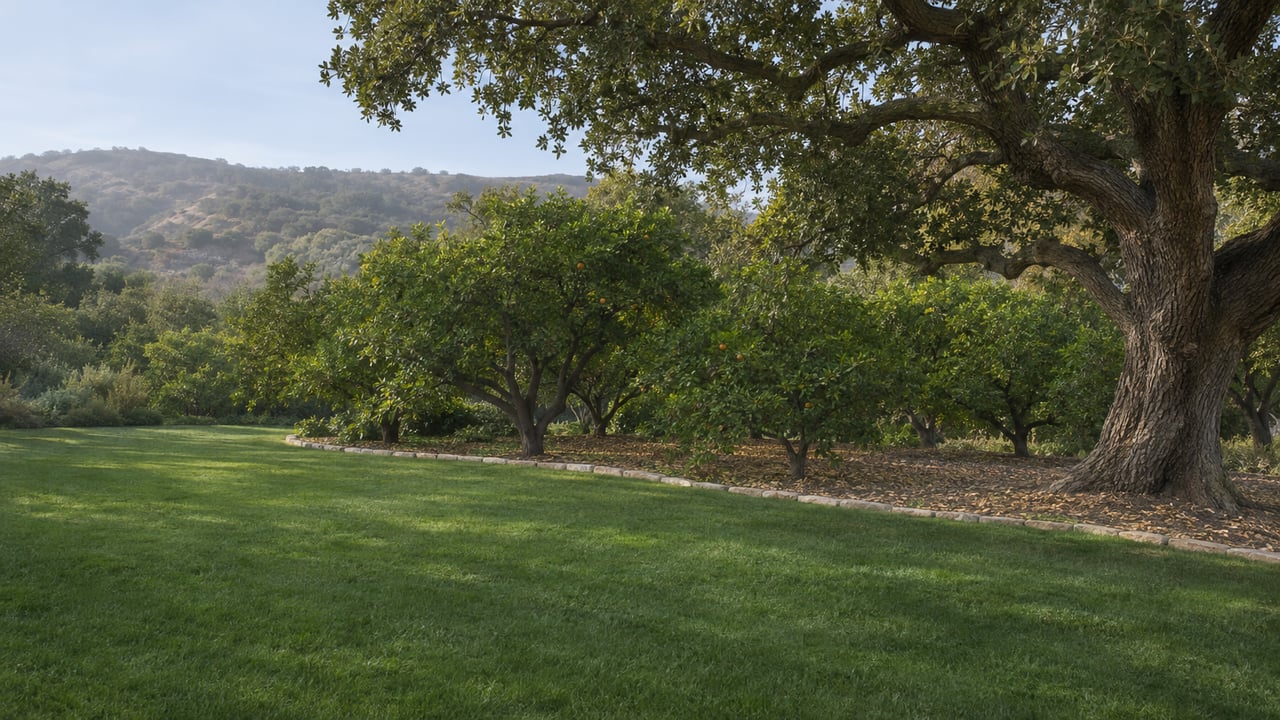
Picture two Santa Rosa Valley parcels that look the same on paper. Each has two acres, a house, an acre of mature avocados and a lawn behind the patio. The listing sheets match down to the septic system. Yet one owner pays less than half as much for each unit of water that reaches the trees this year, and the difference grows every July through 2028. The reason is a second water meter that one parcel has and the other does not.
The meter is easy to miss on a showing. It also shapes the yearly cost of owning acreage here more than almost any line on the property profile.
The meter that came with Santa Rosa Mutual
Camrosa Water District defines the Santa Rosa Valley as the unincorporated area running east from Hill Canyon Road to the intersection of Moorpark Road and Santa Rosa Road, then south and east to Olson Road. It calls the area rural-residential, with lots from 2 to 40 acres. Inside that boundary, about 240 parcels covering about 550 acres in the western part of the valley have dual service, according to Camrosa's 2025 Urban Water Management Plan, finalized in July 2026. Potable water serves domestic use, and non-potable surface water is available for irrigation.
The arrangement predates Camrosa. Those parcels were once served by the Santa Rosa Mutual Water Company, and Camrosa took over that distribution system in 2000. It then kept supplying the same 240 or so large parcels with both kinds of water. The old mutual still shows up by name on Camrosa's current rate schedule as "Non-Potable Residential Landscape (SRM)."
So a parcel's address in the valley says something about its water bill. A parcel inside the old Santa Rosa Mutual footprint may water its trees and turf from the cheaper system. A parcel outside it pays for that irrigation at drinking-water rates.
A rate schedule set through July 2028
On June 6, 2024, Camrosa's board adopted a five-year schedule of water and wastewater rates based on a 2024 rate study by Black & Veatch. The schedule runs from July 2024 through July 2028. On May 26, 2026, the board adopted Resolution 26-12, which put the third step into effect on July 1, 2026. The board packet for that meeting prints every year of the schedule side by side, which makes the long-term picture plain.
| Rate, per HCF | July 2024 | July 2025 | July 2026 | July 2027 | July 2028 |
|---|---|---|---|---|---|
| Potable dedicated irrigation | $4.80 | $5.09 | $5.39 | $5.67 | $6.01 |
| Non-potable residential landscape, SRM | $2.40 | $2.40 | $2.40 | $2.40 | $2.40 |
Between July 2024 and July 2028, the potable irrigation price listed in the schedule goes from $4.80 to $6.01 per HCF, about 25 percent. The non-potable price is $2.40 in every column. As of July 2026, a unit of potable water costs about 2.25 times as much as a unit of non-potable water. At the July 2028 prices, the ratio is about 2.5.
The fixed meter charges move the same way. A 1-inch potable meter costs $35.06 a month as of July 2026 and is scheduled to reach $46.63 in July 2028. A 1-inch non-potable meter costs $12.00 a month in every year of the schedule. Camrosa bills in HCF, or hundred cubic feet. One HCF is 748 gallons, and one acre-foot is 435.6 HCF.
What an acre-foot costs, and how many an acre takes
At the published prices, one acre-foot of non-potable water comes to about $1,045. The same acre-foot from the potable side costs about $2,350 at the July 2026 price and about $2,620 at the July 2028 price. That is a difference of about $1,300 per acre-foot now and about $1,570 in 2028.
The California Avocado Commission's growers' magazine gave a general figure in its Spring 2024 issue: about three acre-feet per acre per year for mature trees at roughly 110 trees per acre. It adds that the real amount varies with location, aspect, heat waves and leaching needs. At that volume, the per-acre-foot difference adds up to roughly $3,900 a year for an acre of trees at the July 2026 prices.
For a lawn, DWR's Spatial CIMIS averages for 2004 through 2021 put Camarillo's reference evapotranspiration at 48.2 inches a year. With the UC and DWR coefficient for cool-season turf and overhead sprinklers, that works out to about 4.3 acre-feet per acre per year, before any credit for rain, so a half-acre lawn takes a little over two acre-feet. Each parcel from the opening, with its acre of trees and half-acre lawn, would use about five acre-feet a year. At the July 2026 prices, that much water costs more than $6,500 more from the potable side than from the non-potable side.
Treat the avocado figure as a planning number. A UCCE-led field study reported by Progressive Crop Consultant in May 2025 measured seasonal crop water use of 2.34 acre-feet per acre at a coastal site in West Saticoy, Ventura, and 3.37 acre-feet at an inland valley site. Those numbers are what the trees used, not what was applied through the irrigation system. A grove's actual bills are the best guide to its volume. Whatever that volume is, each acre-foot carries the same price difference of about $1,300 this year.
What runs through the non-potable pipe
The cheaper water has its own source. Camrosa says on its water systems page that its main non-potable supply is Conejo Creek. The creek carries recycled water discharged by the Hill Canyon Treatment Plant in Thousand Oaks, joined by the Arroyo Conejo, the Arroyo Santa Rosa and smaller tributaries from the valley's hills. Camrosa diverts the creek at the Conejo Creek Diversion Structure just south of the 101, and the water then moves through about 31 miles of separate non-potable pipeline. Camrosa adds that in the hottest months it "uses every drop we can squeeze out of the creek and our ponds."
In the Santa Rosa Valley, groundwater supplements the creek water. Camrosa's own pumping from the Arroyo Santa Rosa basin has shifted toward drinking water. After a treatment system for TCP was built at the Conejo Wellfield, non-potable pumping from the basin fell from 1,460 acre-feet in 2021 to 441 acre-feet in 2025, while potable pumping rose from 251 to 1,529 acre-feet over the same years. The non-potable price on Camrosa's schedule is $2.40 per HCF through July 2028.
Pricing a valley parcel with the meter in mind
Camrosa describes the 240-parcel footprint by area, not by street, so the reliable check is at the parcel level. Ask for recent Camrosa bills, look at which meter classes appear on them, and confirm the service with Camrosa directly. Do this before any offer that assumes a figure for the cost of keeping the land irrigated. Sellers inside the old Santa Rosa Mutual area have a cost advantage they can document, and it belongs in the marketing with the bills behind it. Buyers comparing parcels across the valley can add the yearly water difference to the price comparison, much as they would a difference in insurance or upkeep. Water shapes value in Somis, too, as our post on Somis water rights covered.
The figures above are general information for comparing properties. They are not legal, tax or financial advice, so confirm your own parcel's service and costs with Camrosa and the right professionals.
A few direct answers
Does every Santa Rosa Valley home have a non-potable irrigation meter? No. Camrosa describes dual service on about 240 parcels covering about 550 acres in the western part of the valley. That is the area once served by the Santa Rosa Mutual Water Company.
Can the non-potable water serve the house? No. In Camrosa's description of the dual-service parcels, potable water is for domestic use and non-potable surface water is for irrigation.
What does potable irrigation water cost next year? Camrosa's adopted schedule lists $5.67 per HCF for potable dedicated irrigation in July 2027 and $6.01 in July 2028.
If you own a grove or a horse pasture in the Santa Rosa Valley and want your water costs priced into your listing, or you are weighing two parcels and need the meters checked before you write an offer, talk with The Jenna Kaye Group. Request a private consultation and tailored marketing plan, and bring your Camrosa bills to the first conversation.