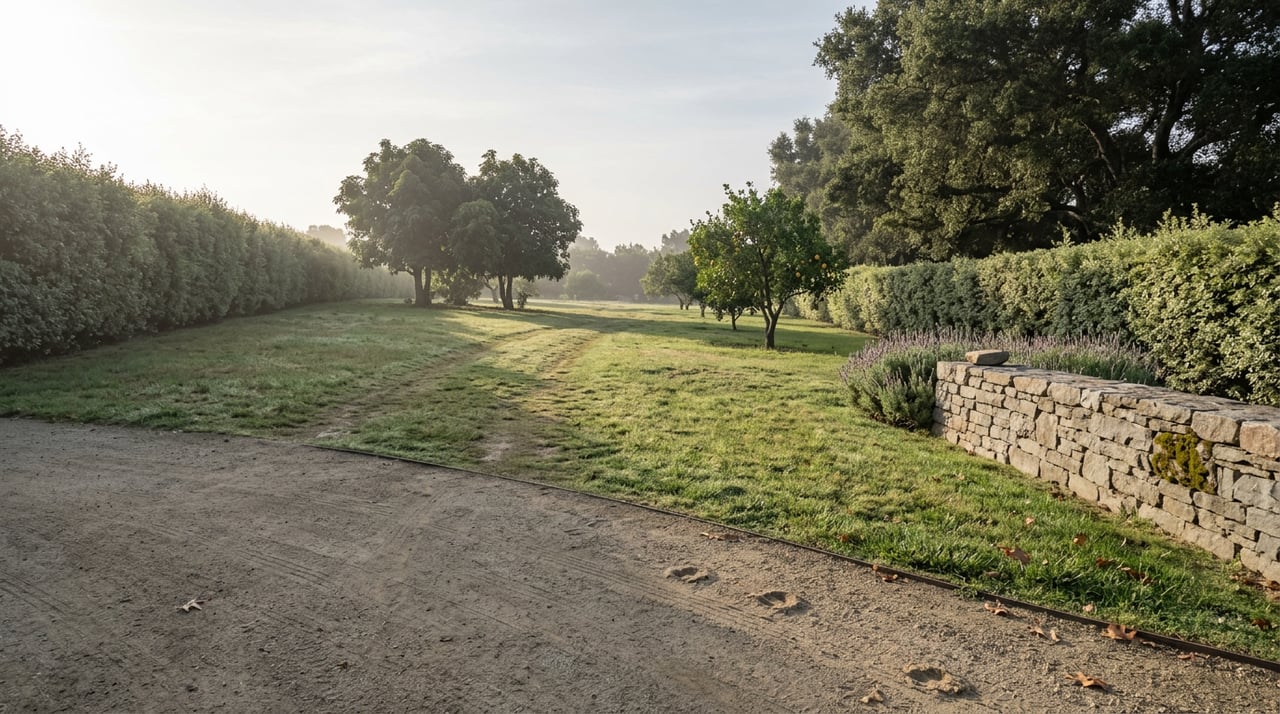
Ride far enough on any of the dirt paths threading through Santa Rosa Valley and you will eventually hit a fence, a locked gate, or a trail that simply stops for no visible reason. Ask a longtime rider why, and the answer is rarely about property lines. It is almost always about who owns the land underneath the trail and whether that owner is willing to accept the liability of letting a horse cross it.
That is the thing about this valley's trail system that surprises even people who have lived here for years. It looks like a single, continuous network stitched together by the county. It is not. It is a collection of separate deals, most of them decades old, held together by one small nonprofit and a lot of goodwill between neighbors.
There Is No Single Map Because There Is No Single Owner
Santa Rosa Valley's trails cross land owned by at least four different kinds of entities: Ventura County Parks, private homeowners' associations, individual ranch owners, and the Ventura County Watershed Protection District, which controls the flood control channels that run through much of the valley floor. Each of those owners has its own rules, its own liability exposure, and its own reason to say yes or no to a public easement.
That patchwork explains something a lot of residents notice but rarely question. Some trail segments have existed for thirty years without incident. Others, sometimes just a few hundred yards away, are still being negotiated county meeting by county meeting. The difference is not the terrain. It is whose signature is required to open the gate.
The Group Holding It Together
Most of what does connect owes its existence to Santa Rosa Valley Trails Inc., a volunteer nonprofit incorporated in 2004 that earned its 501(c)(3) status in 2006 and became fully active by 2007. Its job is unglamorous but essential: securing trail easements on private land, maintaining the multi-use paths that result, and adopting specific trails for long-term upkeep. Two of its adopted routes, the Lower Santa Rosa Trail and the Shooting Star Trail, are maintained entirely by volunteer labor rather than county crews.
This is worth sitting with for a moment. The trails many residents treat as a given amenity, the ones that show up on hiking apps and get recommended in neighborhood group chats, exist because a handful of people spent two decades knocking on doors and negotiating with property owners one parcel at a time. There is no ordinance that guarantees a continuous equestrian network through Santa Rosa Valley. There is a small nonprofit that has been quietly building one.
The Real Bottleneck Is Liability, Not Zoning
The clearest example of why some connections take years shows up in the Watershed Protection District's own meeting records. When a homeowners' association asks the District to grant an equestrian trail easement across its flood control easements, county counsel's standard position has been to recommend against it unless the HOA agrees to fully indemnify the District against defense costs and liability from injury claims. The District treats granting an easement without that protection as inconsistent with its own policy and a risky precedent to set for every other HOA that might ask next.
In practice, that means a trail connection is rarely blocked because the land is unsuitable. It is blocked, or delayed, because someone has to agree to carry the insurance and legal risk if a rider gets hurt crossing a flood channel easement. Ventura County's own Santa Rosa Valley Municipal Advisory Council agendas document this exact negotiation playing out between at least one HOA and the District, with discussions stretching back to at least 2021 before landing in front of the MAC again in 2023.
If you have ever wondered why a trail map shows a gap where a connector logically should be, this is usually why. It is not that no one wants the trail. It is that no one wants to be the one holding the liability if something goes wrong on it.
What Actually Got Built While the Bigger Pieces Stalled
None of this means the valley is trail-poor. Santa Rosa Valley Park, a 50-acre county-owned property on Hill Canyon Road, has grown into the anchor of the whole system. It offers two equestrian arenas, horseshoe pits, and parking large enough to accommodate full-size horse trailers, which matters in a valley where hauling in from an outside ranch is common. From there, the Hill Canyon Trail connects riders and hikers into the much larger Conejo Canyons Open Space, 1,673 acres managed jointly with the neighboring jurisdiction, which in turn links to the 1,430-acre Western Plateau area maintained by the Conejo Open Space Foundation. That corridor is the one piece of the network that functions the way people assume the whole system does: public land, open access, no negotiation required.
The valley's equestrian identity also left physical infrastructure that predates most of today's residents. An equestrian undercrossing at Santa Rosa Road and Glenside Lane was built specifically so riders could cross the road without competing with traffic, a fact that only makes sense once you know the valley was home to an estimated 1,800 boarded horses across private facilities by 1995. Fifteen homeowners' associations built and still share jumping arenas from that era, which is part of why so much of the trail network runs adjacent to private HOA land rather than through it.
More recently, Ventura County added a bike lane along Santa Rosa Road in 2025, giving cyclists and slower-moving traffic a dedicated strip that reduces the friction between cars and the equestrian and pedestrian traffic the road has always carried. It is a small addition, but in a valley where most of the interesting infrastructure fights happen over easements and liability, a straightforward paving project stands out as one of the few upgrades that did not require a decade of negotiation.
What This Means If You Ride, Walk, or Just Want the Gate to Stay Open
The practical takeaway for anyone living here is that the trail system is not a fixed asset the county maintains for you. It is a living arrangement between neighbors, an HOA, a park district, and a flood control agency, and it changes as those relationships change. Santa Rosa Valley Trails Inc. still handles the on-the-ground work of keeping paths passable and pursuing new easements, and the group's ongoing negotiations are the closest thing the valley has to a roadmap for what connects next.
If a segment near you is gated or unusually quiet, it is worth asking whether it sits on Watershed Protection District land before assuming it is simply neglected. And if you board horses or ride regularly, the arenas built by those fifteen HOAs decades ago remain private amenities tied to specific neighborhoods rather than shared community facilities, even when they look open from the trail.
None of this is unique to Santa Rosa Valley in the abstract. Every equestrian community in Ventura County negotiates some version of these same easement and liability questions. What is unique here is how much of the current network exists specifically because a small group of residents decided the negotiating was worth doing, trail by trail, for over twenty years.
That is the kind of detail that matters if you are thinking about property here, not because it changes a listing price, but because it tells you something about how this community actually functions. Land use in Santa Rosa Valley has never been purely a matter of zoning. It has always been a matter of who is willing to sit across the table from a flood control district and work out the terms.
If you are weighing a move into a valley where the trails, the arenas, and the open space all come with a story about who made them possible, the Jenna Kaye Group has spent years learning those stories property by property. Reach out for a conversation about what a specific parcel here actually comes with, easements, access, and all.